
SUPPORT FOR BAKSI'S WOMEN'S CENTER THROUGH “DEDICATED WORKS”
Proceeds from the artworks to be exhibited at Akaretler Sıraevler A23 from November 19 to 28, hosted by Bilgili Sanat, will be donated to support the completion and opening of the Hüsame Köklü Women's Education Center, currently under construction to promote women's education and economic empowerment.
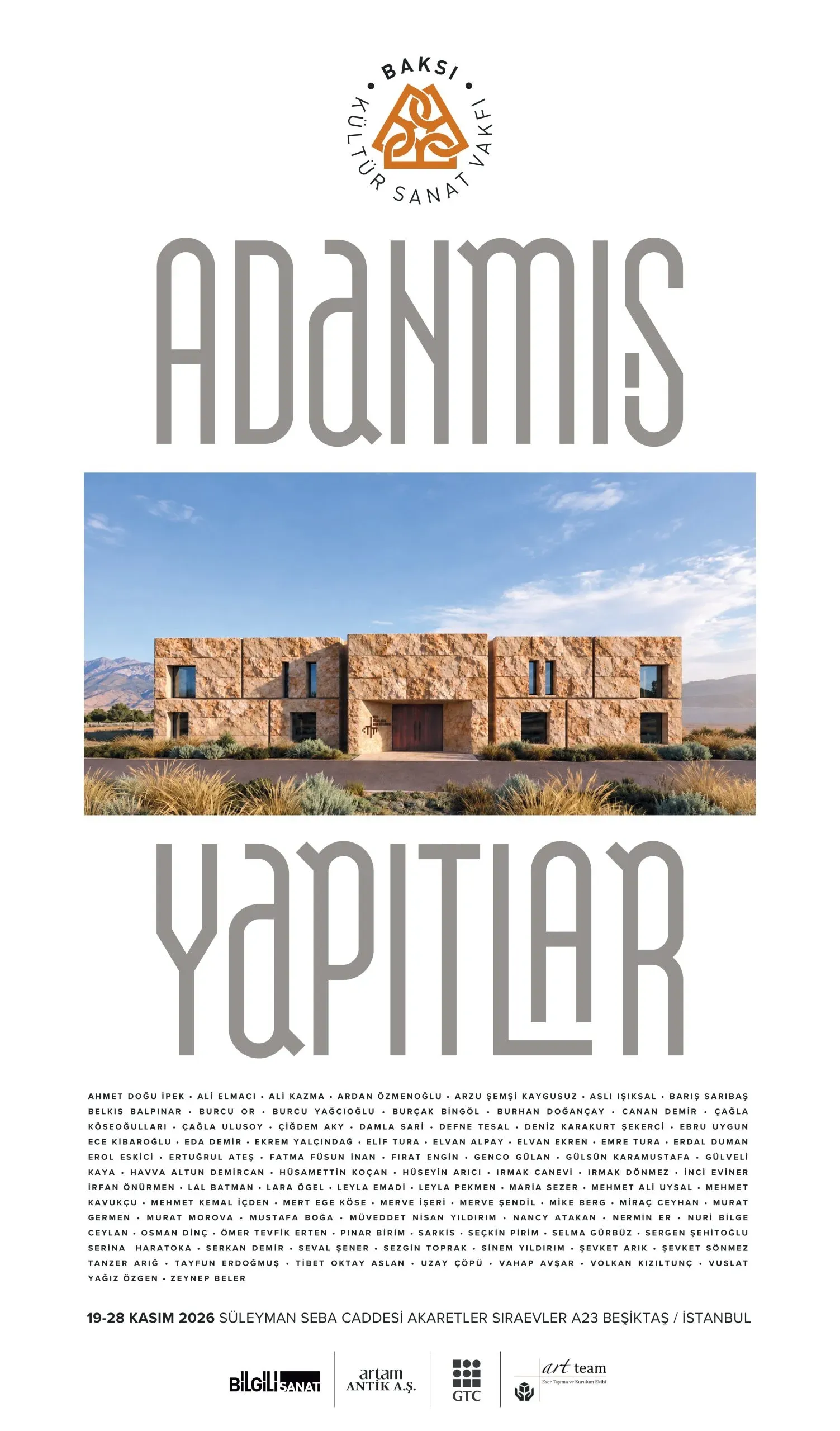
Prepared by Baksı Museum and the Baksı Culture and Arts Foundation as part of the “We Support Women” project, “Dedicated Works” aims to support the completion of the Hüsame Köklü Women's Education Center through artworks donated by artists. Featuring original works by approximately 100 artists, the exhibition will be open to visitors at Akaretler Sıraevler A23, hosted by Bilgili Sanat, from November 19 to 28, 2026. Proceeds from the sale of the exhibited artworks will be used to complete and open the center, which is currently under construction in Bayburt.
Bringing together artists from different generations and disciplines, the selection forms part of a growing initiative of solidarity involving artists, galleries, volunteers, collectors, and art enthusiasts. Through their works, the participating artists are contributing to the establishment of a center where women living in Bayburt will have the opportunity to receive education, develop their knowledge of traditional production techniques, acquire new professional skills, and create their own sources of income.
Prof. Dr. Hüsamettin Koçan, founder of the Baksı Culture and Arts Foundation, explains that the center has been designed as a living space where women can develop their production knowledge and skills while discovering their creative potential. Koçan describes the project's objectives and the artists' contributions as follows:
“With the Hüsame Köklü Women's Education Center, we aim to create an environment where women can develop their existing production knowledge and skills and connect with their own creative potential. By bringing the knowledge and heritage of local culture together with art, craftsmanship, and contemporary design, we want to create opportunities for women to participate more actively in both economic and social life. For us, this center is not merely a building; it is a living space where women's labor becomes visible and where learning and producing together create new possibilities.
This vision has grown from the very beginning through the contributions of our volunteers and supporters. Now, our artists are also supporting the completion of the center by donating their original works. These works, which we have named ‘Dedicated Works,’ bring together the creative power of art and a shared belief in the future. I sincerely thank our artists and everyone who has stood by us throughout this journey.”
From a Land Donation to a Social Initiative
The Hüsame Köklü Women's Education Center originated with the donation of a plot of land by Hüsame Köklü, who lived in Bayburt. Developed under the leadership of Baksı Museum, the initiative gradually evolved into a comprehensive project addressing women's access to education, production, and employment opportunities.
The center's first introductory meeting was held in Istanbul on August 21, 2023, while its foundation was laid at a ceremony in Bayburt on June 3, 2024. The building was designed by Tabanlıoğlu Architects under the leadership of Melkan Gürsel, with contributions from the foundation, volunteer donors, and supporters helping bring the project to life.
The center's location is also significant in terms of its connection to Bayburt. Situated in the city center, on the banks of the Çoruh River and opposite Bayburt Castle, the building has been designed as a meeting point where women from the city and surrounding villages can access educational and production opportunities.
Baksı's approach places particular emphasis on helping women who have migrated from villages to the city center adapt to changing living conditions, acquire professional skills, and strengthen their economic independence. The project also aims to ensure that women living in surrounding villages can benefit from the center's facilities.
In this respect, the project goes beyond establishing a training facility offering courses in specific fields. It aims to enable women to come together to produce, share their knowledge and experiences, pass on skills rooted in local culture to future generations, and transform their products into economic value.
The center's name also reflects this local connection to Bayburt. While the land donated by Hüsame Köklü marked the beginning of the initiative, the project's scope has gradually expanded into a broader model of education and production.
Education Ranging from Ehram Weaving to Digital Design
The seven workshops planned for the Hüsame Köklü Women's Education Center will bring together traditional production methods with contemporary design and commercial skills.
The center's areas of activity will include fashion and production, ehram and traditional weaving, design and branding, natural dyeing, traditional crafts and embroidery, digital design and e-commerce, and entrepreneurship training.
Ehram weaving, which holds an important place in Bayburt's local culture, is one of the program's key areas of focus. In addition to preserving traditional weaving knowledge and maintaining production, the program aims to reinterpret these products through contemporary design approaches.
Training in natural dyeing, embroidery, and traditional crafts will also provide opportunities to develop local production knowledge across different disciplines. Fashion, design, and branding activities will focus on connecting the objects produced with contemporary uses and market conditions.
The inclusion of digital design, e-commerce, and entrepreneurship in the educational program demonstrates that the project addresses the entire production process, extending to sales and marketing.
The aim is not only for women to create products but also to acquire the skills needed to promote them, develop brands, sell through digital platforms, and manage their own businesses. In this way, the project seeks to strengthen the connection between traditional craftsmanship and economic life while enabling local products to reach broader markets.
Sustainable production also plays an important role in the foundation's approach. Educational and workshop activities are planned around slow production, recycling, upcycling, and environmentally friendly practices.
Through collaborations with local and international designers, brands, and various producers, the products created by women are expected to gain access to new design opportunities and sales channels.
A Model Connecting Education with Employment
Beyond providing vocational skills, the center's program also encompasses the social and institutional support women may need to sustain their production activities.
The building is planned to include complementary facilities such as a childcare center, library, guesthouse, and gallery. In addition to supporting educational activities, these spaces will allow women to come together, exchange experiences, and exhibit their work.
Baksı's project plan also includes conducting training programs with the contributions of volunteer instructors and sponsors from various fields of expertise.
Specialists such as designers, producers, and legal professionals are expected to participate in the training programs. Courses are also planned in areas including art, general culture, traditional handicrafts, family and childcare, and personal development.
Topics such as digital commerce and sales through social media will also be addressed to help women transform their production activities into economic opportunities.
One of the project's long-term objectives is to enable women who complete their training to eventually become instructors in their respective fields, passing on their knowledge and experience to other women.
This approach aims to ensure that the skills acquired at the center extend beyond individual development and spread throughout the local community.
Planned activities also include supporting women who acquire professional skills in establishing cooperatives and their own businesses, as well as bringing products created at the center to domestic and international markets.
Museum shops, fairs, exhibitions, and various retail outlets are among the channels being considered to connect these products with consumers.
This approach represents a broader ambition than simply preserving traditional production as cultural heritage.
By combining local knowledge and skills with contemporary design, digital commerce, and entrepreneurship opportunities, the project aims to establish a production ecosystem that supports women's participation in economic life.
The center is also expected to strengthen women's involvement in social and cultural activities.
Baksı Museum's Experience Rooted in Local Culture
The Hüsame Köklü Women's Education Center builds upon the cultural and artistic vision that Baksı Museum has developed over the years.
The idea for the museum was conceived in 2000 by Bayburt-born artist and academic Prof. Dr. Hüsamettin Koçan, and its main building was completed in 2010.
The Baksı Culture and Arts Foundation was established in 2005 to bring this vision to life. With contributions from artists and volunteers, the museum evolved into a cultural institution that brings contemporary art and traditional handicrafts together under one roof.
Located on a hill overlooking the Çoruh Valley in Bayraktar village, Bayburt, the museum encompasses an extensive complex featuring exhibition halls, a storage museum, workshops, a conference hall, a library, and a guesthouse.
Alongside contemporary artworks, Baksı's collection includes examples of folk paintings and local handicrafts, reflecting its aim to establish a connection between art and traditional production culture.
This approach plays an important role in preserving cultural memory and ensuring that local production traditions continue to exist within contemporary life.
In 2014, Baksı Museum received the Council of Europe Museum Prize. Awarded following an evaluation involving 37 museums from 22 European countries, the prize brought international recognition to the museum's model of integrating contemporary art with local culture.
Baksı's approach in Bayburt is based on the belief that art should not be limited to institutions and audiences in major cities but should establish a direct relationship with the cultural and social life of the region in which it exists.
The Women's Education Center represents a new phase in this experience.
The museum's commitment to preserving local culture and production knowledge now focuses on expanding educational and employment opportunities for women.
By bringing traditional weaving, craftsmanship, and handwork together with contemporary design and digital commerce, Baksı continues its approach of engaging with cultural heritage beyond simply exhibiting it.
Once completed, the center aims to transfer this knowledge and these skills through educational programs and integrate them into economic life.
Participating Artists in “Dedicated Works”
The “Dedicated Works” exhibition brings together artworks donated by artists from different generations and disciplines.
The selection features works by Ahmet Doğu İpek, Ali Elmacı, Ali Kazma, Ardan Özmenoğlu, Arzu Şemşi Kaygusuz, Aslı Işıksal, Barış Sarıbaş, Belkıs Balpınar, Burcu Or, Burcu Yağcıoğlu, Burçak Bingöl, Burhan Doğançay, Canan Demir, Çağla Köseoğulları, Çağla Ulusoy, Çiğdem Aky, Damla Sari, Defne Tesal, Deniz Karakurt Şekerci, Ebru Uygun, Ece Kibaroğlu, Eda Demir, Ekrem Yalçındağ, Elif Tura, Elvan Alpay, Elvan Ekren, Emre Tura, Erdal Duman, Erol Eskici, Ertuğrul Ateş, Fatma Füsun İnan, Fırat Engin, Genco Gülan, Gülsün Karamustafa, Gülveli Kaya, Havva Altun Demircan, Hüsamettin Koçan, Hüseyin Arıcı, Irmak Canevi, Irmak Dönmez, İnci Eviner, İrfan Önürmen, Lal Batman, Lara Ögel, Leyla Emadi, Leyla Pekmen, Maria Sezer, Mehmet Ali Uysal, Mehmet Kavukçu, Mehmet Kemal İçden, Mert Ege Köse, Merve İşeri, Merve Şendil, Mike Berg, Miraç Ceyhan, Murat Germen, Murat Morova, Mustafa Boğa, Müveddet Nisan Yıldırım, Nancy Atakan, Nermin Er, Nuri Bilge Ceylan, Osman Dinç, Ömer Tevfik Erten, Pınar Birim, Sarkis, Seçkin Pirim, Selma Gürbüz, Sergen Şehitoğlu, Serina Haratoka, Serkan Demir, Seval Şener, Sezgin Toprak, Sinem Yıldırım, Şevket Arık, Şevket Sönmez, Tanzer Arığ, Tayfun Erdoğmuş, Tibet Oktay Aslan, Uzay Çöpü, Vahap Avşar, Volkan Kızıltunç, Vuslat, Yağız Özgen, and Zeynep Beler.
The artworks donated by the participating artists bring together diverse forms of artistic expression around a shared purpose: supporting women's education and participation in economic life.
In this respect, “Dedicated Works” stands out not merely as an exhibition but as an initiative that helps transform the value created within the art world into a lasting space for education and production in Bayburt.
The exhibition will be open to visitors at Akaretler Sıraevler A23, hosted by Bilgili Sanat, from November 19 to 28, 2026.
Proceeds from the sale of the exhibited artworks will be used to support the completion of the Hüsame Köklü Women's Education Center.

